

Artificial Intelligence
The National Hive Mind: When AI Reaches Energy Parity with Human Expertise
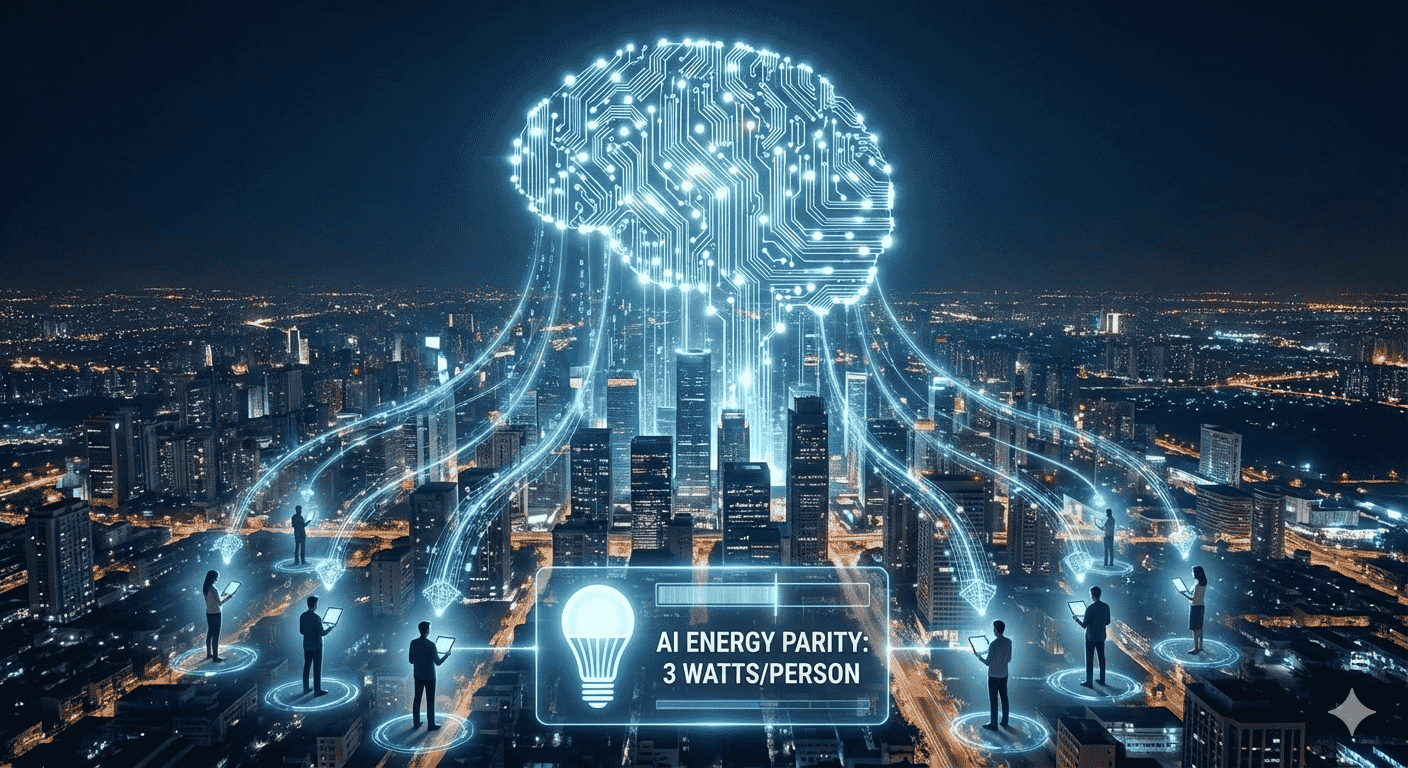
For the power of a single LED bulb, every citizen could access daily expert-level intelligence at national scale.
How Much AI Inference Does a 1-Gigawatt Data Center Really Deliver?
A growing narrative claims that AI is running into hard limits: power, energy, and infrastructure. That claim does not survive contact with basic arithmetic.
Using today’s hardware and today’s models, a single 1-gigawatt (GW) AI data center already delivers more inference capacity than an entire population can realistically consume. This article walks through the numbers and explains what that means for AI infrastructure, energy economics, and the so-called “AI bubble.”
No speculation. Just current-state math.
What 1 Gigawatt of AI Compute Actually Means
A 1 GW facility is large, but it is not hypothetical.
| Metric | Value |
|---|---|
| Utility power | 1,000 MW |
| Typical PUE | ~1.1 |
| Power available to compute | ~909 MW |
Facilities at this scale are already being planned and permitted.
Hardware Assumptions (Conservative)
This analysis assumes current-generation inference hardware, not roadmap claims.
| Component | Assumption |
|---|---|
| GPU class | H200-class |
| GPUs per node | 8 |
| Sustained draw per node | ~8.5 kW |
| Total nodes | ~107,000 |
| Total GPUs | ~855,000 |
This fits cleanly inside a 1 GW envelope with standard cooling and redundancy.
From Power to Inference Capacity
Raw inference throughput
Benchmarks on production-grade language models show approximately: ~3,000 output tokens/sec per GPU
| Metric | Value |
|---|---|
| Total output tokens/sec (raw) | ~2.5B |
| Tokens/day (raw) | ~2.2 × 10¹⁴ |
The reasoning tax (the part most analyses omit)
High-quality answers require internal reasoning. A conservative assumption of 100 reasoning tokens per output token yields:
| Metric | Value |
|---|---|
| Net output tokens/day | ~2.2T |
| Tokens/person/day (330M people) | ~13,000 |
| Approx. words/person/day | ~10,000 |
Power cost per person
| Metric | Value |
|---|---|
| Power per capita | ~3 watts |
| Equivalent | Small LED bulb |
Conclusion: Expert-level reasoning is already cheap at scale.
Image Generation (Quality-Adjusted)
Raw image benchmarks overstate real output. Applying a ~5× quality penalty to match modern, high-fidelity generation still leaves massive surplus capacity.
At this scale, limiting image output is a product decision, not a hardware constraint.
Energy Economics: Power Is Not the Bottleneck
| Metric | Approximate Share |
|---|---|
| Share of U.S. electricity | ~0.2% |
| Capital cost (order of magnitude) | ~$50B |
| Dominant ongoing cost | Hardware refresh, not power |
Electricity matters—but hardware lifecycle economics dominate. Claims that AI will imminently stall due to energy limits are overstated.
What This Actually Says About the “AI Bubble”
A surface reading of these numbers raises a fair question: If 1 GW already delivers ample daily inference for an entire population, why are hyperscalers targeting 50 GW+ buildouts?
The answer is not “waste.” It is workload mix.
- Inference for text reasoning is already abundant
- Training frontier models is not
- Video, real-time simulation, and interactive environments are far more compute-intensive
So the real issue is not whether the buildout is excessive—but whether additional capacity is being converted into durable capability, or just raw output.
We’ll address that distinction directly in a future post.
Why This Matters to HitWit
At HitWit, we focus on using AI to deliver cognitive depth to everyone, not bespoke intelligence for a few.
That requires:
- Multimodal content tailored to an individual’s current cognitive state
- Grounding in the information they need to act
- Economics that work at population scale, not consulting scale
Understanding real inference capacity and energy costs is foundational to building systems that meet those criteria.
Read the Full Technical Analysis
For full assumptions, benchmarks, and sensitivity analysis, see the white paper: